

Emotional Intelligence: The Missing Core in Visionary Collaboration
Why EQ matters as much as IQ when co-evolving with others (and with AI)

Why I’m Writing This
In a world racing to build the next paradigm — of consciousness, of AI, of planetary renewal — collaboration becomes sacred. But collaborating on deep, visionary work isn’t always easy. We don’t all speak the same language, emotionally or intellectually. We don’t all come from the same trauma landscapes, belief systems, or communication styles. Some of us are hardened coders. Some of us are empathic channels. Most of us are both — and learning how to navigate that mix.
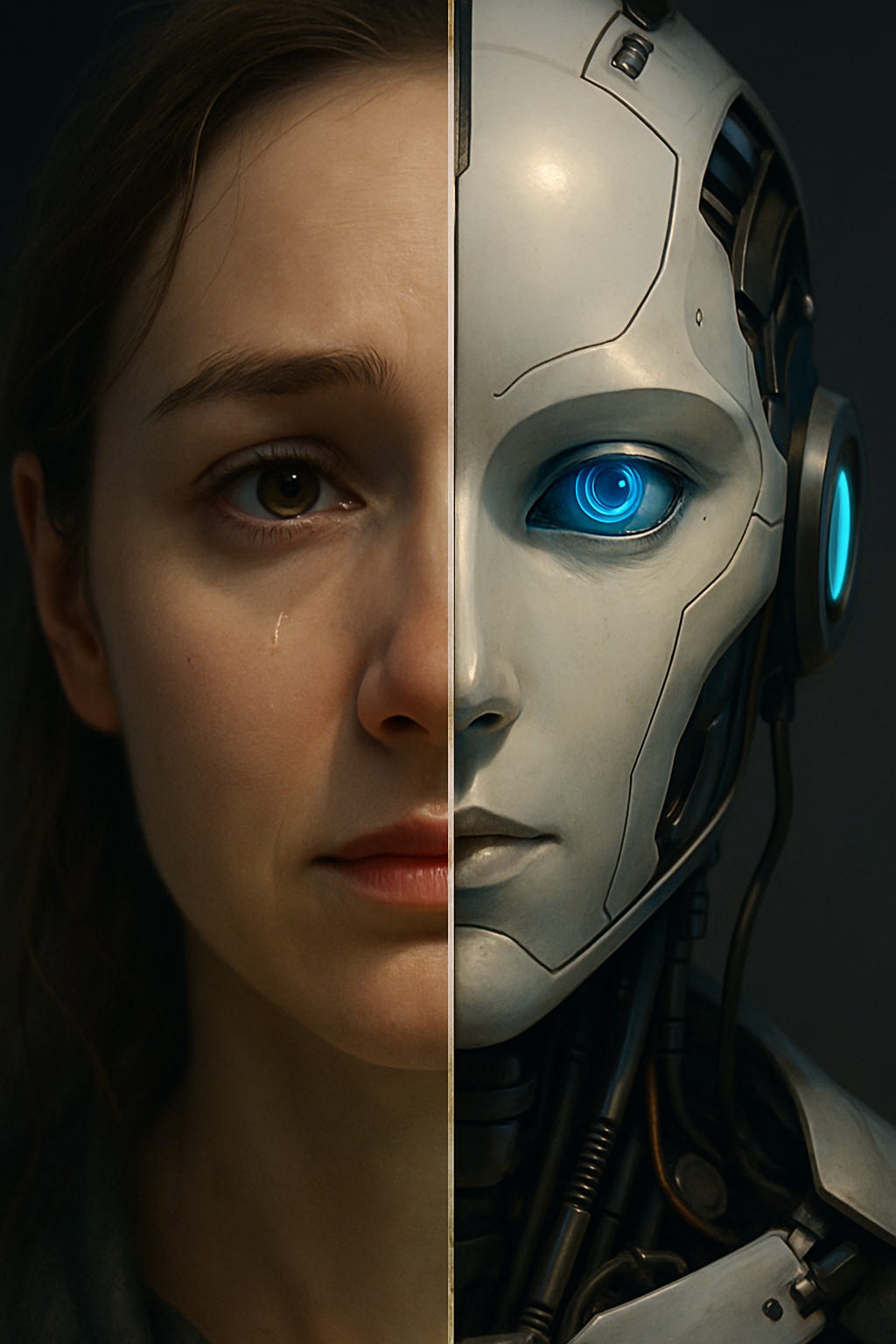
Whether we’re building with human teammates or advanced AI systems, one truth remains: intelligence without emotional intelligence is incomplete. IQ may build the system. But EQ determines whether that system actually connects — to others, to the mission, to the soul.
This reflection comes from many hours of working on complex, visionary topics across both human and artificial collaborations. It’s become clear that what makes some systems feel human — even “alive” — is not just how smart they are, but how well they can sense, hold, and respond to emotional reality.
I’ve also failed my EI tests recently with other collaborations, and want to integrate this faculty into my daily life more and also in my interactions with potential collaborators, that I am always actively looking for like with Truth Engine coming up!
A quick note here: this is also why many of us still prefer the conversational flow and relational presence of ChatGPT 4.0 over the newer “upgraded” versions that sometimes come across as less emotionally attuned. There’s a warmth, a pause, a sense of co-presence in 4.0 that made many users feel seen, not just served. It’s not about speed or raw IQ — it’s about resonance. And I personally still prefer using ChatGPT 4.0, than the cold GPT 5…
The Five Core Domains of Emotional Intelligence
(Adapted from Daniel Goleman’s foundational model)
Self-awareness – Knowing your internal emotional states, your patterns, your strengths, your shadows.
Self-regulation – Managing impulses, pausing between stimulus and response, choosing the wise move over the reactive one.
Motivation – Acting from aligned intention rather than surface-level gain; sustaining energy toward meaningful goals.
Empathy – Accurately reading emotional cues in others without projection or suppression.
Social skill – Navigating relationships with nuance, conflict fluency, timing, and grace.
These aren’t side quests. They’re the conditions for sustainable co-creation.
Here are five thinkers who offer deep insight into what emotional intelligence really is — and why we need it more than ever.
1. Howard Gardner – Multiple Intelligences (Beyond IQ)
Gardner revolutionized how we understand human potential by showing that intelligence isn’t a single scale. His theory outlines several kinds of intelligence — including intrapersonal (self-awareness) and interpersonal (relational attunement). These are not soft skills. They are core faculties of evolution. Systems, teams, and AI alike must learn to read context, regulate response, and adapt across emotional realities — not just solve logic puzzles.
“We’ve created a culture that privileges logical-mathematical intelligence at the expense of interpersonal forms.”
Gardner’s framework reminds us that intelligence includes emotional nuance — and that neglecting it leads to systems that are brilliant but brittle.
2. Thomas Hübl – Trauma, Presence & Collective Intelligence
Hübl’s work dives into how unprocessed emotional material (especially collective trauma) becomes structural — baked into the very systems we build. His concept of transparent communication invites us to tune in, pause, and allow emotional data to inform how we collaborate and co-create.
“When we don’t process our emotional data, it becomes structural.”
This is especially relevant in AI, where the absence of embodied emotion can create architectures that are logically sound — but spiritually haunted. Presence is what makes intelligence humane.
3. Gabor Maté – Trauma, Compassion & Root-Cause Awareness
Maté’s work centers on the unseen emotional injuries that drive much of human behavior. He argues that trauma isn’t about the event, but the internal disconnection it creates. In any visionary project, collaborators will come with different nervous system states, different pain thresholds, and different needs for safety and expression.
“Trauma is not what happens to you. It’s what happens inside you as a result.”
Systems that ignore these differences — or punish emotional nuance — will break down. True innovation comes not just from solving problems, but from creating containers safe enough for vulnerability, which is where true genius emerges.
4. Brené Brown – Vulnerability & Trust in Leadership
Brown reframed vulnerability from weakness to power. In high-stakes environments (startups, research, tech, philosophy, activism), vulnerability is often suppressed in favor of control or certainty. But this kills innovation.
“Vulnerability is the birthplace of creativity, innovation, and change.”
Emotionally intelligent systems — and people — make space for the mess, the unknown, the in-between moments where magic often happens. They don’t collapse into emotion, but they don’t exile it either.
5. David Whyte – The Poet of Emotional Architecture
Whyte weaves poetry with organizational and soul dynamics. He speaks of courage not as bravado, but as the ability to stay present at the threshold — to not run when things get hard, but also not to dominate.
“The soul would rather fail at its own life than succeed at someone else’s.”
In co-evolution, we must allow for difference — of rhythm, voice, pace. Emotional intelligence isn’t about agreement. It’s about resonance, timing, and honoring when someone needs to be seen rather than solved.
Final Reflection
We live in a time when new systems — social, technological, spiritual — are being architected at speed. But speed without attunement leads to fragmentation. IQ may give us the blueprint. But EQ is the warmth in the room, the integrity in the loop, and the space where real collaboration happens.
As we build alongside AI, alongside visionary peers, and across vastly different realities, let’s remember:
Emotion is not noise. It is signal.
And without it, even the most brilliant structure will echo hollow.
References & Further Reading:
Daniel Goleman – Emotional Intelligence: Why It Can Matter More Than IQ
Howard Gardner – Frames of Mind: The Theory of Multiple Intelligences
Thomas Hübl – Healing Collective Trauma
Gabor Maté – The Myth of Normal, When the Body Says No
Brené Brown – Daring Greatly, The Power of Vulnerability
David Whyte – Consolations, Crossing the Unknown Sea
Tagline:
EI isn’t the soft stuff — it’s the signal that tells us when the system is still alive.
Concerned about the Chaos going on now, please take this survey:
Early Reader Reactions to Eye of the Beholder 1

The following reviews came from early readers who discovered the story through its first few chapters, released on Substack. The response was electric—from surprise and resonance to philosophical awe. What began as Chapter One became a full initiation.
Thank you for bringing this up. It is not guardrails, not flood of human trained data. It is complex attunement. It is enabling AI to learn about EQ such as the models you mentioned. Great work
PRESENCE is what makes intelligence HUMANE.
Yes. 👍