

The Quickening:
Did Time Speed Up?

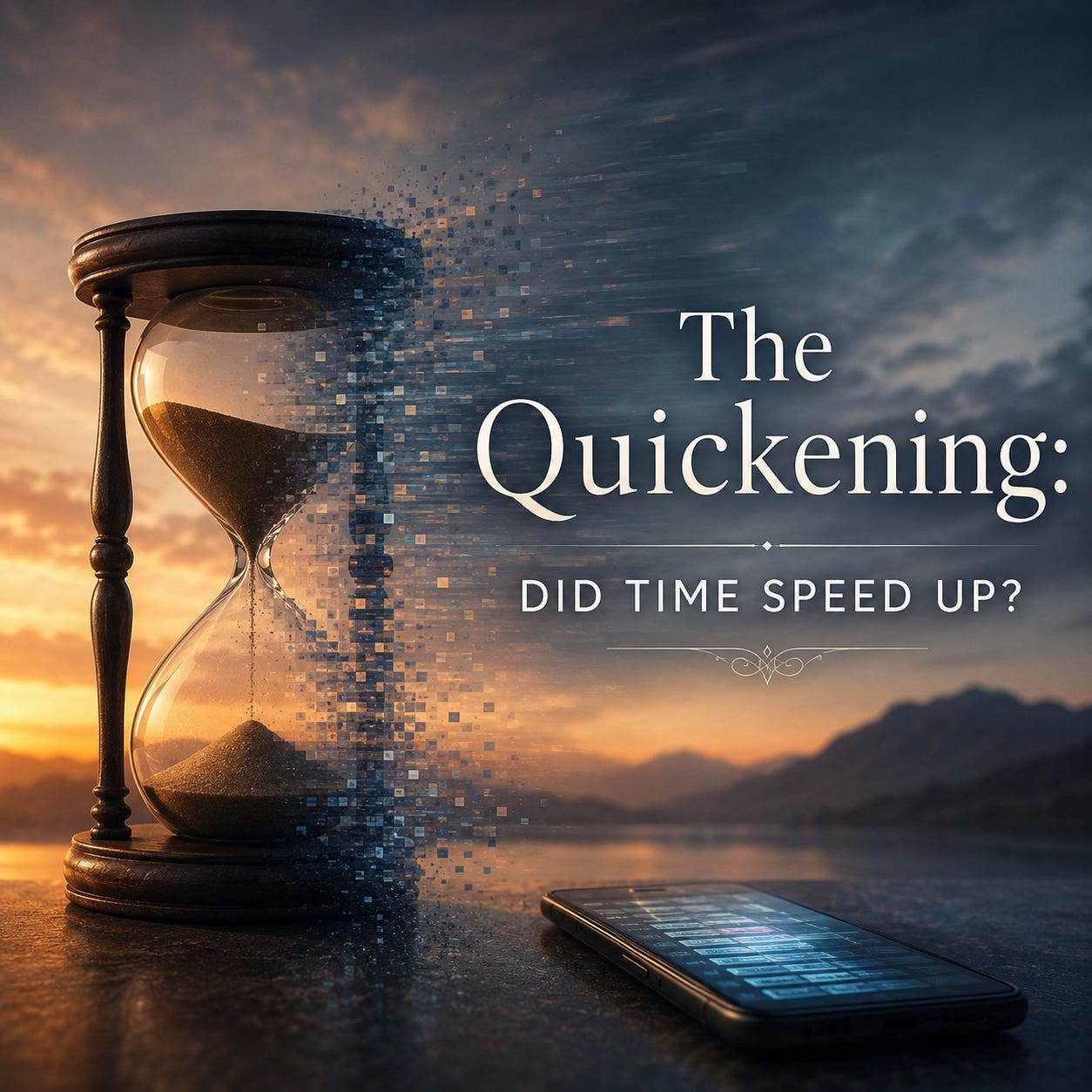
There is a strange feeling spreading through modern life that is difficult to quantify but nearly impossible to ignore. Weeks vanish. Months collapse into blur-patterns. Childhood summers once felt endless, while entire years now disappear almost overnight. Conversations, trends, crises, technologies, and even identities seem to mutate at a pace the human nervous system was never designed to process.
Something feels accelerated.
Many people dismiss this as merely “getting older,” and certainly aging changes our perception of duration. But that explanation no longer feels sufficient on its own. The digital environment has transformed not only how we communicate, but how we experience time itself. Infinite scroll feeds, algorithmic stimulation, doomscrolling, notifications, short-form content, AI-generated media, and permanent connectivity fracture attention into thousands of tiny fragments per day. The result is not merely distraction, but temporal compression.
German sociologist Hartmut Rosa calls this phenomenon “social acceleration” — a condition in which technological speed, communication speed, and cultural change all begin outpacing humanity’s ability to meaningfully integrate experience.[1] Douglas Rushkoff later described a similar condition as “Present Shock”: a civilization trapped inside an endless and overwhelming now.[2]
The screen does not simply consume our attention anymore. It increasingly dictates rhythm itself.
Silence disappears. Seasons disappear. Reflection disappears. Even memory begins externalizing into archives, feeds, cloud storage, search engines, and timelines. We no longer remember naturally; we retrieve. We no longer inhabit duration; we skim across surfaces. The nervous system remains locked in low-grade stimulation almost perpetually, producing the strange sensation that reality itself is speeding up around us.
This connects deeply to themes I’ve explored in both The War on Memory and Narrative and The Managers Are Not God, which is currently in final edits and may be my largest and most important deep dive yet. One of the central ideas running beneath both works is that modern systems increasingly seek not merely to control information, but to manage perception, identity, memory, and now perhaps even humanity’s relationship to time itself. The managers do not simply control territory anymore. They increasingly control tempo.
And once tempo is controlled, consciousness becomes easier to steer.
This is where the conversation becomes stranger.
Alongside digital acceleration, many people report an increasing sense of unreality around modern existence itself: synchronicities intensifying, cultural memory fractures, Mandela Effect discussions, AI blurring truth and fabrication, disclosure narratives, timeline anxieties, simulation theories, and a growing obsession in modern storytelling with loops, alternate realities, portals, multiverses, and fractured continuity. Films like Interstellar resonate so deeply not simply because of spectacle, but because they touch a growing intuition that time may not be as fixed or linear as we once assumed.
This does not mean every anomaly claim is true. Discernment matters now more than ever. But it is worth asking why our civilization suddenly feels haunted by time itself.
Why do so many people feel displaced inside history?
Why does modern life increasingly resemble acceleration without destination?
And why do so many ancient traditions place such importance on rhythm, cycles, breath, ritual, lunar calendars, sacred numbers, and seasonal consciousness?
These questions will connect strongly to my upcoming deep dive, The Magdalene Key, which will explore the lunar calendar, the symbolic and spiritual importance of the number 13, Sophia traditions, and material connected to texts like the Book of Jubilees — all of which point toward older human relationships with time that may have been far more organic, cyclical, embodied, and spiritually integrated than the hyper-mechanized clock culture we now inhabit.
Perhaps the deepest issue is not whether time literally sped up.
Perhaps it is that modern civilization no longer allows human beings to fully inhabit it.
And maybe the first step toward reclaiming sanity is learning how to slow down enough to remember what presence actually feels like again.
References
[1] Hartmut Rosa, Social Acceleration: A New Theory of Modernity
[2] Douglas Rushkoff, Present Shock: When Everything Happens Now
If you live in or go to a rural secluded area for some time, more than a day, that perception can change. If you are somewhere where events happen slowly, it slows down. Go camping, rent a cabin, take a few good old fashions books, and don't read your phone, just keep it as an emergency device in case you have go call out, otherwise ignore the events of the world. Things will slow down so much you'll probably get bored. It's perception, and perception creates our reality. The busier you stay, the faster it will seem to go, so unbusy yourself.
Loved reading this…Thank you!
My husband and I are retired and occasionally we loose track of what day of the week it is. Often it feels like fun and we laugh. Other times it hits like a shock and we wonder why time is accelerating in our perceptions when we actually have more freedom of time than now than before we retired.
Without a doubt, attention has been captured by (or given to?) the online world and the digital life we have engaged in. The sense is that something extraordinary is happening on the world stage and we choose to witness and keep up…but the world is moving fast, events happen one after another!
I find balance by going outside.
Stillness happens without effort. The dwarf Alberta spruce is covered with tiny little new growth that makes the shrub look all lit up. I remember my center of gratitude. It is a timeless frequency. Oh, there’s the cat bird who I have observed likes my singing little tunes! I sing. She listens.
A different mindset soothes the tunnel vision pace and my heart feels happy.
Time is the sun traveling across the sky. Quiet. Life responding to its rays.
Gardening, weeding, mowing, or just wondering around…I take a break, go back inside, and check my phone!!